In 1877 the prairie to the north of our home was a rolling plateau of bunch grass. The stage road from Lewiston, where the steamers came up the Columbia from the coast, to Mt. Idaho, where the Milner trail wound through the mountains to the goldmines of Florence, would have been a dusty track winding below the high points and above the lows, holding elevation without unnecessary climbs. The energy of teams moved the world in those days, and the coach drivers and freighters knew their horses, their loads, and the mechanics of their big, wood-hubbed wheels.
In mid-June Chief Joseph’s band of Nez Perce were at camp at Tolo Lake, west of the stage road some miles. They had left their beloved Wallowa Valley and were coming in to the new Lapwai reservation. On their final night of freedom, a few young men rode down onto the Salmon River where the homesteaders had their homes and began a vengeful night of savagery and pillaging. They began with men they knew personally who had mistreated the Nez Perce, but by morning they were killing indiscriminately. They killed women and children, burned homes and barns, ran off stock. More warriors joined them and the violence spread like fire.
Cottonwood House was a stage stop on the prairie about 17 miles from Mt. Idaho. Ben Norton, his wife Jennie, and their ten-year-old son Hill lived at Cottonwood House raising horses and putting up travelers. Jennie’s 19-year-old sister, Lynn Bowers, lived with them, as did Ben’s partner in the stage stop, Joe Moore. They had gotten word of Indian trouble and were uneasy.
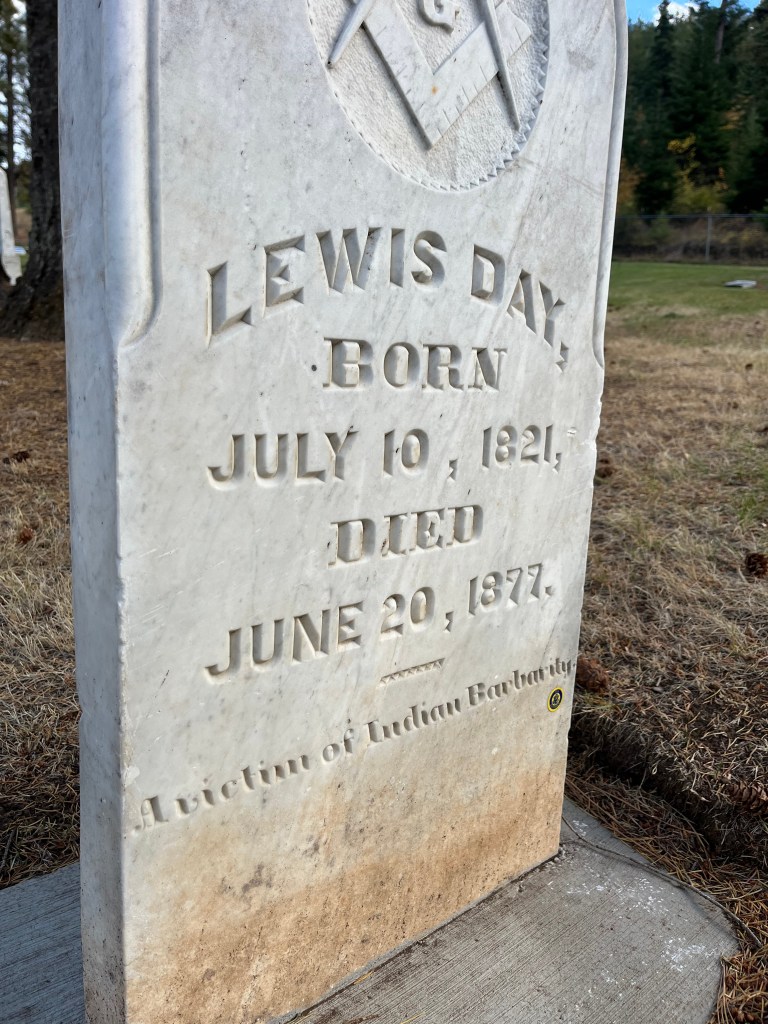
The evening of 14 June, a lone rider rode up to the stage stop and got off his horse. Lew Day, was carrying a dispatch from Mt. Idaho to Captain Perry in Lapwai. Settlers, he said, were streaming into Mt. Idaho for protection. He mounted a fresh horse and left.
Before he was out of sight, a wagon rolled up. John Chamberlain, his wife, and their two small daughters were on their way to Lewiston with a load of flour. After some hurried conversation both families decided to make a run for Mt. Idaho. John Chamberlain turned his team and wagon around and the Nortons, fumbling with the haste of their rising fear, gathered some valuables and essentials and prepared to leave.
But now Lew Day was riding back in from the north, slumped in his saddle. He had only left Cottonwood House a few miles when a few Nez Perce had come riding up and joined him on the road. He was uneasy about their intentions and after riding with them a ways Lew told them he was getting cold and rode on ahead. At a muddy spot in the road his horse slowed up and one of the Nez Perce raised his rifle and shot Lew in his back. Lew galloped into cover and returned fire, at which the Nez Perce disengaged and left. Lew hurried back to Cottonwood House. Ben Norton and Joe Moore dressed his wound as best they could and helped him into the wagon.1
It was now night, and the party left for Mt. Idaho. John Chamberlain pushed his team after Ben Norton and Joe Moore who rode out front. The team was tired and the wagon loaded. The bright moon came and went behind clouds. The women murmured prayers and Mrs. Chamberlain held her two daughters close.
They were well over halfway to Mt. Idaho, about seven miles away, their hopes rising, when from behind them suddenly came horses and gunfire. John Chamberlain shouted and lashed at his tired team, the women moaned in terror.2 Joe Moore and Ben Norton on their horses returned fire. The night sparked with muzzle flashes and pounded with hoofbeats.
Joe Moore’s two fingers were shot away and his horse killed. Ben Norton was hit in his leg and his horse went down. One of the team was hit, then the other. Bullets popped and splintered through the wagon, the children wailed from the bottom of the wagon bed. The men shouted at each other, at their families. Lew Day, drawn and bleeding, climbed under the wagon and began shooting from behind a wheel. Joe Moore and Ben Norton retreated to the wagon and joined Lew Day. Joe Moore took a bullet through his hips. Lew Day was hit again, in his leg.3
Everyone was now under the wagon. The men fired at the dark forms cirling them and the Nez Perce drew back. The women huddled over the children. The firing subsided to the occasional flash from the prairie where the warriors waited and milled around. The men all were hit and bleeding except John Chamberlain.
Lew Day began to fever and ask for water. “My kingdom in heaven for a drop of water!4” Ben Norton, moved by the pleas of the wounded Lew Day, rose and reached for the water jug on the back of the wagon. As he stood on the hub he was shot in his thigh. He fell back down, his femoral artery severed, and lay bleeding out under the wagon. His wife Jennie begged to go out to the Nez Perce and plead for their lives, and the dying Ben Norton finally agreed. Jennie got up and was immediately shot through both legs5. She cried “My God, I’m shot!” and crawled between the dead horses.
John Chamberlain gathered his family and ran into the night on foot. In the darkness John became disoriented and instead of toward Mt. Idaho, he led his family toward Tolo Lake and the band of Nez Perce. The group under the wagon heard shots and Mrs. Chamberlain screaming on and on.
Ben Norton told Lynn Bowers and his son Hill his goodbyes and told them to run for Mt. Idaho on foot. Jennie, from where she lay between the dead team, said for Hill to stay but Ben, now almost too weak to talk, said, “He’ll be killed here anyway.” Lynn Bowers took off her skirt and she and Hill crawled into the night. Ben Norton died soon after.
Under the wagon the night went on, Ben Norton now slumped silent in death, Lew Day and Jennie Norton stiffening and moaning and fevered by their wounds. Joe Moore kept up steady fire, holding off the restless band of warriors. He crawled around and pulled all the firearms to himself and emptied each one. When the ammunition was gone he loaded shotgun shells with pieces of rifle cartridge and held off the hostiles until morning6.
Morning came and Jennie began crawling through the grass toward Mt. Idaho for help.
Frank Fenn was scouting north and west of Grangeville early the next morning and saw movement in the grass. He rode forward, thinking he’d spotted a skulking Indian. As he approached, the person rose to his feet and clapped his hands and cried “It’s Mr Fenn-it’s Mr Fenn!” It was Hill Norton. Frank Fenn had been his school teacher.
Fenn and Hill Norton galloped east for help, and after leaving Hill in Grangeville Fenn and two other men hurried back up the stage road toward the scene of the attack. They loaded the wounded survivors into the wagon bed, pulled the saddles off their horses and patched the harnesses off the dead team onto their horses. The reins had been broken, and as they were harnessing the horses a distant party of Nez Perce was seen. They each got on a horse and set off at a dead run down the long slope toward Grangeville flailing at their mounts with the halter ropes. At the bottom of the slopes the Indians appeared behind them and began gaining rapidly as the horses slowed on the level ground. A large relief party from Grangeville appeared, firing at the Indians, who then pulled back and rode off.
The men hurried back to the scene again and found the Chamberlain family in the prairie grass. John Chamberlain and three-year-old Hattie were dead. The youngest daughter, with an arrow in her and her tongue partially severed7 was found hiding under her dead father’s knees. Mrs. Chamberlain was in the grass with an arrow in her chest. She had been assaulted repeatedly and was in a hysterical condition.
Lynn Bowers was found along Three Mile creek, “nearly hysterical with fear.”8
The wounded were taken to Mt. Idaho and put up at L.P. Brown’s hotel. Lew Day’s leg was amputated a few days later in an attempt to save him but he didn’t survive the operation. Joe Moore lingered for six weeks before dying of his wounds.
The story is short. A few paragraphs at the most in a few old history books. When I drive the Camas prairie under a good moon in June I look north and can almost see the dark box of a wagon, a team down and the muzzle flashes of Joe Moore’s rifle. When the fathers finally lay dying in the grass and the moon dimmed for them what did they say that no one heard?
John and Hattie Chamberlain, Ben Norton, Lew Day, and Joe Moore are buried about a mile and a half from our house, under the big pines of the Mt. Idaho cemetery. My family and I walk through from time to time and I always pause at the tilted quartz headstones. Other men, other families, another time, but on the same prairie, the same place.


————————————————————————————
1 Some accounts have Lew Day riding with Ben Norton and Joe Moore. I have tried to piece together from different accounts what seems to me most likely.
2 It’s always the women, the mothers, who I think of most in these stories of frontier violence. Men have always been men, with our intuitive physicality and our adrenaline-driven reactions in the chaos and gunfire of combat. We have it in us to ride and fight in the night. But the mothers of families, the wives of husbands. These women bore the fear, the anxiety and the angst of holding Hattie and her baby sister, helpless, while the savages shot down their husbands and closed in.
3 Native Americans were generally poor shots. The fire arms they had were old and dirty, and theirs was not a culture that valued or understood mechanical principle. The Nez Perce were the exception. Throughout the war, they became known and feared for the accuracy of their rifle fire, as evidenced by the unusually high casualty rate of this attack. Within minutes the Nez Perce hit almost every adult in the Norton/Chamberlain party, who were on the ground, in the darkness, behind wheels and dead horses.
4 Lew Day was said to have said this, but when and where I couldn’t tell. Was it under the wagon, or later in Mt Idaho, in LP Browns hotel? Was this when Ben Norton finally got up and reached for the water jug?
5 Hill Norton, in his later telling, says they were all under the wagon soon after the attack began. But other accounts have Jennie shot when she stood to jump from the wagon, and when hit she jumped or fell down and sprained her ankle. By some tellings both her legs were broken. This would square with her “dragging herself” through the grass the next morning toward help. But the first care she received at LP Brown’s hotel in Mt. Idaho was having a silk handkerchief run through her leg wounds, which seems an unlikely first aid action with both legs broken. We also have a letter from Jenny to her family describing how in the days following the attack she stood on the porch of the hotel every morning and could see Cottonwood House, obviously being able to walk and stand, and a report in the Lewiston Teller, a newspaper, described her leg wounds as “not serious”.
6 Jenny Norton spoke later of the “heroism” of Joe Moore. With a bullet through both hips and two fingers gone he single-handedly held off the Nez Perce. What he was doing with the shotgun shells though? Did he have ammo but no rifle for it? Maybe the rifle was above him in the wagon, out of reach. How could shotgun shells be re-loaded? How did he get the re-loaded shells to spark, with no primers? But in the black of night, shot through the hips, with his bloodied, three-fingered hand, keeping up steady return fire he re-loaded shotgun shells with empty rifle cartridges all while “speaking constant reassuring words of comfort” to Jenny and Lew Day.
In a better world Joe Moore would have lived and married the plucky Jennie Norton whom he saved and comforted that night and they would have kept Cottonwood House together and on rides to Mt Idaho shown their wagon of children where Daddy lost his fingers and got his limp and saved Mama.
Instead, in the world we live in, Joe Moore “lingered” for six weeks before dying.
7 The partially severed tongue of the one-year-old Chamberlain daughter was the subject of common discussion. The more luridly inclined speculated the cries of the child enraged the warriors assaulting Mrs. Chamberlain and they seized her ankles and dashed her head against the ground causing her to bite her tongue. Various other scenarios were imagined. No one ever knew.
8 Mrs. Chamberlain was “found in a hysterical condition” and Lynn Bowers was “nearly hysterical with fear”. It is hard to imagine a greater contrast between the worlds these frontier women lived in and the lives they desired. There was no Ballerina Farm, no Instagrams of sourdough loaves in wooden bowls under linen towels, no romanticized homestead lifestyle. Every fibre in their bodies longed to be cultured, christianized, and civilized. The Victorian expectation of a good woman was very narrow: a woman of white, delicate complexion, with the highly strung disposition of an aristocratic European noblewoman, her nervous system one report of red-skinned savagery from hysterical collapse. The reports of the “hysterical conditions” were kindnesses from their rescuers. Family and friends from back east would know these women, for all the hardships of pioneer life, still retained the well-bred sensibilities of civilized christian womanhood. A few of the female victims, having suffered the “fate worse than death”, hid themselves from public view for shame. There was no therapy, no understanding of trauma responses, nothing to help these women process rape and assault. One of the victims simply smiled sweetly and reported she had been treated “kindly” by the warriors. Better a lie.
9 about a mile north of 95 on Zumwalt Road, to the east, on the high ground.
 Borderlands
What a story.
Sheila
LikeLike
Thank-you for sharing this story!
We live such soft, predictable, easy lives and tend to romanticize the olden days. But they were bloody, costly; and many died young. I thank God I am in this space and time, and it is because they pioneered the way before us.
There are many stories of Sullivan raiding and destroying Indian villages in our area here in New York. The historical markers are just whispers from the past. Atrocities were committed in God’s name that God hates.
No matter how we spell it, humanity without God is doomed to ruin. If only we could bind up the brokenhearted and lift up the hands that hang down. Then, in 150 years, we will have made a difference in history.
LikeLike