
When I turned 40, I got my Bearcat revolver and a box of cartridges and laid them on our kitchen table. I brought my spotting scope, my road atlas. I carried up my sleeping bag, two hats, my leather carry bag, a sheath knife, my Leatherman. Around my neck I hung a steel medallion on a leather thong.
“What’s the gun for, Dad?” my children asked.
I did not answer but turned slowly to face them. I narrowed my eyes to indicate I was going places and doing things no man would go and do unarmed, and the nature of the situations I would seek out could not be spoken of to children. They were silent, wide eyed.
I laid a wool shirt on the table, my swimming trunks, my Bible, a water bottle. I added my ear buds.
“You coming back, Dad?” asked my children.
I said I’d be back.
When I turned 40, Amy inquired after my heart’s desire and I said I was going to Montana to discover the man I had become. I borrowed a car from my friend JR. I told Amy where I would go and she made arrangements. She put together music and money for me.
I packed the car, an old tan Toyota Camry, unobtrusive and unnoticeable, as I wished it to be.
Amy and I slept on our porch swing for a few hours, and at midnight I kissed her and drove into the night. She retired to our bedroom and locked the doors.
The gravel crunched under my tires in the darkness. Down our driveway, Mill Creek Lane, Mill Loop road, Poor Farm Road, Highway 13 to Highway 12. Three hours to the Montana border at Lolo Pass. I drove with my right hand on the wheel, my coffee mug in my left, audio in my ears. The car drove Toyota easy. The black night gave way to my headlights which roamed right and left across the white and yellow lines and the trees and rock sidewalls of the Lochsa River Canyon, and across the foaming rapids of the river running heavy with June water.
Down the Montana side of Lolo Pass, elk were in the road. A cow trotted across and behind her came a tiny calf, high-stepping awkwardly on the unfamiliar hard surface. I swept by behind it and sensing danger, it folded its legs and lowered its head to the pavement under my mirror. My father’s heart was moved. Small things doing what they know in a hard world. Mine were in their warm beds.
South through the Bitterroot until the hills pushed in and the road wound up Camp Creek and at Lost Trail I went east to the Big Hole. At the Big Hole battlefield, where Gibbon’s men attacked the sleeping Nez Perce, I pulled off and stepped out into the empty parking lot. The sun was not yet up and mist rose off the meadows. I was alone. I sought, on this journey, those voices of spirits of the past, the present. Come talk to me, Jesus, talk to me, the cosmos, the past, the deep rich truth of things. I was alone and waiting. The mist rose and I could nearly hear the bark of the Springfields and the screams of the Nez Perce. What is time on a journey like mine? 145 years is but a moment, eclipsed by the ageless connections of our humanity. I was one of Gibbon’s men “firing low into the tipis” as instructed. I was a Nez Perce warrior on his horse.
The morning was silent, verdant in June. A lone antelope stood in the sage, unmoving. I watched it. Was it a doe looking to fawn, wracked by birthing pangs? An old buck? Was it the spirit animal of a warrior, of his child bayonetted as it ran crying from his burning tipi? I backed away and left. Above me, on the side of Battle Mountain, elk were grazing.
I drove across the high open hay ground of the valley, through the worn town of Wisdom, up the long grade to Big Hole Pass, and on my right I came to a model of a beaverslide hay stacker within a rail fence, with interpretive signs. The old freighter’s road from Dillon crossed through here, the parallel ruts of the heavy wheels still cut into the hillside above.
I stepped to the roadside interpretive signs. One was an excerpt of Meriwether Lewis’s journal, and I read it on that cold June morning.
“This day I completed my thirty first year, and conceived that I had in all human probability now existed about half the period which I am to remain in this Sublunary world. I reflected that I had as yet done but little, very little indeed, to further the hapiness of the human race, or to advance the information of the succeeding generation. I viewed with regret the many hours I have spent in indolence, and now soarly feel the want of that information which those hours would have given me had they been judiciously expended. but since they are past and cannot be recalled, I dash from me the gloomy thought and resolved in future, to redouble my exertions and at least indeavor to promote those two primary objects of human existence, by giving them the aid of that portion of talents which nature and fortune have bestoed on me; or in future, to live for mankind, as I have heretofor lived for myself.”
A chill wrapped my spine. On the first morning of my quest, this. I looked across the valley. Me too, Meriwether, me too. 40 years in this Sublunary world and same, soarly feel the indolence of the years unjudiciously expended.
Four years later Lewis was dead. Dead at his own hand in an inn in the dark woods of Tennessee. I am no stranger to that darkness and fog that in Lewis’ day would have been known as melancholy. I feel it, Meriwether.
I took a photo of the plaque and sent it to Amy. She had instructions. Do not shoot yourself yet.
I dashed from me my gloomy thoughts and got back in my car.
Dillon, 15 north, past Beaverhead Rock, and up into the lodgepole plateaus of the river of Yellow Stones. The open river valleys of the upper Yellowstone are theatre to an ecological trinity: the bison, the big bears and the wolves. In the past the bison were the suns of western plains. The sheer mass and wealth of their flesh and bone were the engine of the ecosystem, around which the bears and wolves revolved and the swirling fields of energy and life that rose and fell in their passing. The vast grasslands of the interior West and Midwest were groomed, energized and shaped by their passing. Today only an echo, only a shadow of this drama plays out in a few isolated areas.
At a turnout in Hayden Valley, I took my sleeping pad and bag, my spotting scope, and crossed the sage over a rise. Out of sight of the road I hiked to the edge of the lodgepoles and slept. I awoke, later, set up my scope and began probing the highlands around me. About a mile away I found them, a half-dozen bison grazing on a hillside, and above them, three wolves. The bison were giants, bulls, a few bedded and a few on their feet. Between them and the wolves a snowbank lay below the crest of the hill. The wolves sat in the sun, much like me, waiting on nightfall or watching for movement below. Maybe they were denned behind the hill. They sat, they wandered in circles. One crossed the snow and circled up a bison. The bison lowered its head and rushed the wolf. The wolf diverted and returned to the hilltop. I studied the terrain, mapping an approach. If I got the wind on them and came up the back side of the hill, it could work out. But Alum Creek and its sloughs cut between us, and I let the thought pass.
Back on the road, more bison bulls, behemoths the weight of a pickup. Old bulls, alone, bedded here and there in the spring grass, resting from the long snows of winter. It came to me to find an old bull and engage. The bull would need to be out of sight of the road, alone, with his back to some trees. I would belly crawl up to him, slap his rump, and sprint into the trees. I was fast in my younger days. I never lost a race until I was 35, and this would be the finale, the final run. An old, 2000-lb. bison bull, a cloud of dust, an Anabaptist father and husband running for his life in the sagebrush. If I pulled it off, the story would be pure gold for the grandbabies. But the bulls either were too close to the road, too far from trees, or bedded with other bison. That and the plan did have a whiff of the idiotic about it.
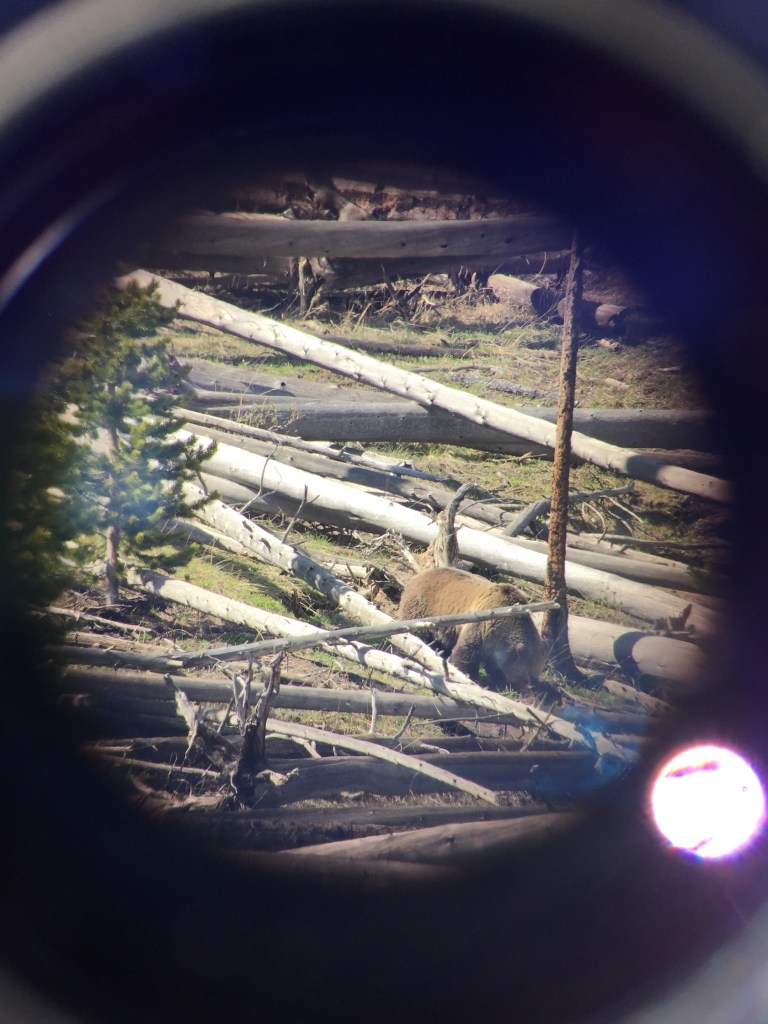
I went east from Yellowstone Lake and in an old burn the cars were lined up. I got my scope out and above us digging ground squirrels in the burn was a grizzly. It seemed to be a younger bear, a sandy blonde, moving among the fallen lodgepoles with the chilling grace and ease of its kind. It dug and rooted. The sun shone on my back, there was good glass under my eye and a bear to watch. My joy was full.
I stayed in Cody that night, and ate at the Buffalo Bill’s Irma Hotel Restaurant and Saloon. It was ornate and historic, full of Bill’s people: older gentlemen with whiskers and bellies and boots and buckles, and big-haired women. Cowboy MAGA chewing their slabs of rare steak, bluffing and grizzling about back when a man could do as he pleased. I sniffed disdainfully and ate what I ate, I can’t remember, fish or something.
The next morning early, east on 14 across Wyoming’s high sage plains. Coming into a little river bottom town, a big mule deer buck trotted up onto the road. I stood on the brakes and threw left hard, tires wailing, and he flashed past the passenger window. Goodness! So close I spent the day on the shoulder with a busted car and no more journeying for me.
Up Shell Creek into the Bighorns as the earth spun me into the sun lighting the red rock canyon walls. The road lay on the mountain in loops. I climbed up into sunlight, up onto rock benches affording views of the banded red limestone and granite headwalls. A turnout invited me off the road. I closed my door softly and was completely and deeply alone, yet with the Creator’s hand on my shoulder. The clean air moved on my face, the silence thundered off the rock walls. The unfathomable pages of the past lay closed in the wrinkled ochre bands and yet here my breathing, conscious body stood. My Creator’s hand, like I said, was on my shoulder and His other hand rested on the rock mountain. I breathed deep, I did not think or fend, I only drew in what came and was undone and overrun on that morning in the Shell canyon of the Bighorns.
I pulled myself together, got back in my car and went over the top where snow lay so deep still only the tops of the fence posts dotted the open areas. It was June 3rd already. All the way down to Sheridan to the Houlihan Ranch where Buck Brannaman was hosting a colt starting clinic at his home place. I paid my fee to Reata Brannaman and took a seat on the slope above the arena.
Buck’s horsemanship began with the Dorrance brothers, Bill and Tom, who grew up poor and hardscrabble in Oregon working with horses and cattle like any other in their times. They were small men, with neither money, education nor means. All they had were bright, curious, observant minds. By the late nineties they had single-handedly revolutionized horsemanship without lifting a finger or spending a dime. They recognized a few simple principles universally at work in living creatures, and through observation and humility presented them to their horses. The horses responded so intuitively and willingly as to amaze and confound anyone who knew horses.
The sound of Buck’s voice in his microphone took me back to the years in my early twenties. Young, hungry, impressionable, idealistic. Buck’s philosiphy fascinated me like few things ever have, and I was deeply, fundamentally changed by the years I spent with my horses.
I left the Houlihan and drove north to the Custer battlefield, east of Billings, above the Little Bighorn River, and stood in the June wind where Custer’s body was found. The broken grasslands lay much the same as 150 years ago. Across the river below, traffic on I-90 moved soundless north and south.
“O could you but have seen some of the charges that were made! While thinking of them I cannot but exclaim Glorious War!” wrote George Custer in 1863 of his Civil war cavalry charges. Yellow Hair, as the Sioux knew him, was the quintessential army man of the mid-nineteenth century. To the swooning ladies, he was dashing, noble, finely bred, charming—descriptors that curl our toes today. On the rise where I stood, Custer’s entire five companies of 210 men died, overrun by a mixed force of over a 1,000 Lakota, Cheyenne and Arapahoe warriors. Like every visitor to this site, I wondered what the final minutes were like. Did Custer, in those last moments, finally realize that the brave, courageous, noble spirit was in fact only the reckless insecurity of a man relentlessly in pursuit of recognition, fame and fortune, and this time, in this final round of his Glorious War, he had over-played his hand? Or was he his own hero to the bitter end?
I felt no contempt though. No judgement from me. Don’t we all play our games, our own Glorious Wars in which we lead the charges? Where our beliefs about ourselves cost others?
At Billings, I left the sun and the wind of the ranch lands for the hushed, close ambience of the Yellowstone Art Museum. Time retreated; context faded. I moved slowly from room to room, in and out of lights, soft music. I was obedient to art’s suggestions, responsive to its whispers. I stood long at a large display of the native plains people’s shields. The heaviest bison shoulder rawhide on circular frames turned arrows, lances, sometimes musket balls at angles, but the real power, to its warrior, was in the art on its face. Ocher, charcoal, tallow. Men on horses, horned bulls, exaggerated lances and arrowheads, suns. Fallen enemies spouting blood. Scalps and strips of fur dangled from the shields, claws and beads. Unseen, the shields held the incantations, the chants and implorations of ceremony and ritual over smoky fires of sage and incense. These shields—did they in other planes and dimensions still speak to powers, still move the dark energies of the tribes?
I moved to the abstract pieces, the chaos and swirls of color and reached for meaning. I am here for the work of art, for symbol and rhythm and evocation, but too often in the celebrated slather of slung paint I see only the emperor’s naked belly riding by and I will not fawn on his robe. Too many years a country boy, too much cultural insecurity. I moved on before too much reflection revealed more.
Across the river were caves with pictographs. My plan had been to move from our art to their art, from now to back then. Would my movement across the river of time coalesce the essence of human artistic expression? But the park was closed and I was foiled.
Amy, feeling pangs at putting me up in Cody in a 2-star motor inn, had something far better in mind for me that night. The Northern Hotel was historic. It rose tall and red-bricked, with understated signage. Quiet, expensive. I approached the dark depths of the parking garage with rising anxiety. Kiosks, parking, tickets, rising and lowering traffic control arms. I will get it wrong, I will be confounded.
In my dusty, tan Camry I rolled up to the kiosk and glared desperately at its face. The arm was up but I knew one did not just drive in. You needed a ticket. But there was no ticket button, no place that said GET TICKET. Insert credit card, it said. Of course they wanted my money. I inserted my card. Behind me, in my mirrors, other vehicles were waiting. Big Jeeps, black and silver SUVs with lights on in the day. My Camry’s lights only came on after dark. The kiosk had sucked in my card. It was blinking. I waited. I slid low into my seat. More and more gleaming cars were in line behind me, spilling into the street.
My card was gone! Where was my card! The SUVs began honking. I sank lower in my seat. I pushed every button I could reach. My card was gone into the machine! Suddenly men in black suits surrounded my car. Drive forward, drive in! They waved and motioned me forward. “It’s got my card!” I hissed.
They bent low into my face. “Just drive in, drive in!” I sped forward into the darkest furthest corner and got my things. The men crowded around the kiosk and extracted my card. I tried to make light of it, of being in over my head, et cetera et cetera. They looked at each other and disappeared.
The Northern was very nice. I walked down the street and ate at a small place with spot lighting and quiet people. The waitresses were discreet and left me alone. I had a drink and talked to myself. Who cared about parking smooth. I was 40 now. I would focus on what mattered.
The next day, I visited Scott Groskopf’s Buckaroo Business store. The finest of the fine rawhide reatas, saddles, bits, reins. Beautiful work, braiding and tooling in the vaquero traditions. The smells of leather and the gleam of silver.
I was growing restless. Time to go, time to go. East to Bozeman and the Museum of the Rockies. Outside is a pioneer homestead, a tipi. Old freight wagons, buggies, doctors kits, a planetarium. Inside, the Siebel Dinosaur complex, with its world-class collection of Triceratop and Tyrannosaurus Rex exhibits. Rows and rows of giant skulls, a forty-foot T-rex skeleton, one of the most complete we have.
I moved slowly, softly, taken into the unfathomable worlds of our past’s deep time, the inexorable progression of the ages, slowly, eternally moving into the coming completeness of our Christ. An eye socket, a tooth, a sketch of the Mesozoic fauna would fracture my consciousness of the immediate, the rational, the constraints of Newtonian thought, and for just an instant, I was gone over the wall into the cosmic immensity of other realities. You know what I mean? Just a glint, a glimpse.
Back on 90 West, it was time for home, time to go. I wanted Amy. What were my children doing? Playing, fighting, talking. I got on the big road, eased the needle north of 80 and set the cruise. The massive white Absarokas stood heavy in the south, the Big Belts north. Over the hill into the Jefferson River Valley, the Tobacco Roots, Homestake Pass. Butte’s richest hill on earth, the grass of Deerlodge, and finally Missoula. Right on 12 at Lolo, back over the pass and down the long winding Lochsa. By evening I was home.
There were other things happened I cannot speak of to you. I did not fire my revolver, I did not stare death or destruction in its eyes, I did not finally, finally see myself as I never had before. But I had moments, I was reasonably wild and free, and at the end all I wanted was to go home.
 Borderlands