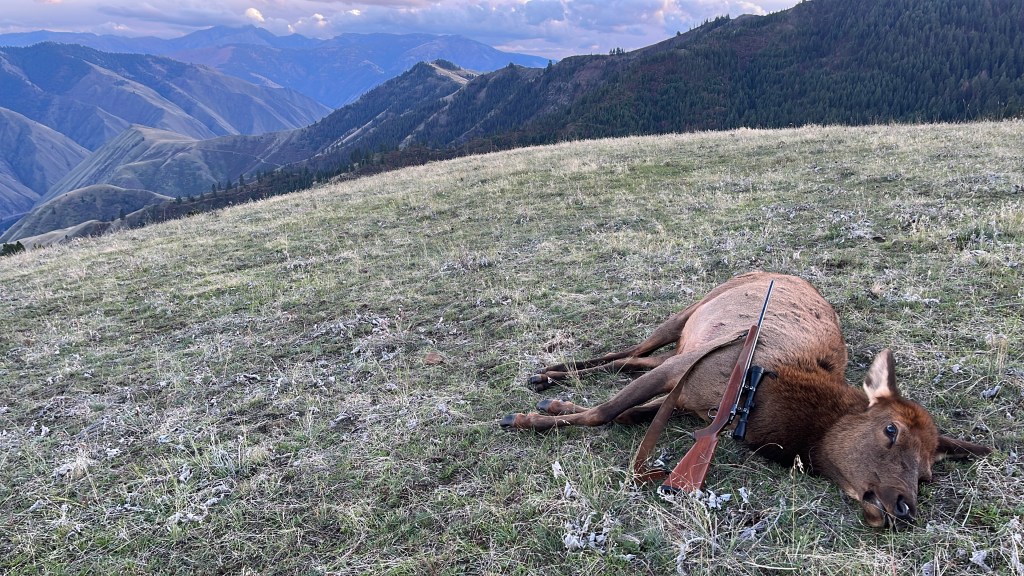
All afternoon I sit in the bunchgrass on an open hillside. The elk are below me in a grassy bowl, on private land, just out of sight. I can hear the bulls bugle, imagine the herd sprawled in the sunlight, ears droopy and rocking to the rhythm of their cud chewing jaws. I lay in the sun and sleep, waiting.
When the sun lowers and the blue dusk climbs out of the canyons, the elk will stand and feed up into the meadow where I wait. They will taste the wind, watch, listen. Idaho rifle season has been open for weeks. They are cagey and paranoid. They are hungry and they fear for their lives, suspended in the tension of these pulls that define their existence. The smells, the sounds, the intuitions and instincts are a constant rolling feed of stimuli and each animal, behind its dark liquid eyes, craves our earth’s holy grail: life.
The sun goes down and the elk come up out of the trees. A big cow, the lead cow, has followed the feel of her eyes and nose and she will eat now. She walks out into the meadow, grazing, tacking left then right. She stands looking across the valley of the Salmon in the hushed dusk like a seer in the desert.
I lay my rifle across my pack and shoot her low behind her shoulder. The nose of my bullet mushrooms open and her chest cavity liquifies in a bloom of crimson violence. The mountain cradles the echo of my shot while she runs a half circle and stands, waiting, alone, staring unseeing at the trees. I can only see the top of her back and back of her head. I shoot three more times, my cross hairs dancing on the fist sized spot between her ears. Noise is everywhere–the crash of my rifle, the metallic shucking of my bolt, my pounding heart. I am riding a wave of muscular and mechanical blitzkrieg, unthinking and unfeeling. It is a place I go when I kill, to do what must be done. My third shot punches through her skull and she disappears.
I walk to the cow and touch her unblinking eye with my rifle barrel. I am quiet now, always undone by this moment, never quite ready for the raw brutality, injustice and finality of death.
Who am I to take life from another? Who has made me the arbiter of her life flame? I have taken from her for me. She has left her body so I can inhabit mine. I touch her warm shoulder. There is no value to assign to life, no price to put on a beating heart, but for a hunter who lives with the apostle Paul’s words “ye are bought with a price, therefore glorify God in your body…”, this moment brings a bright, particular clarity to the truth. The Lamb was slain so that I might live. For my body to live, other bodies must die.
In the death of the Lamb my complicity haunts me, changes and shapes me, as it does in this bloody, carnal sacrament, the hunt. I have killed, taken a life, my hunter’s soul is burdened. There is blood on my hands. I am beholden. What will I do with this life?
In the descending dark on the mountain I pull my cold knife and skin off the top side of the cow. I run my knife under her shoulder blade and lift the front quarter into a game bag. The hind quarter is harder: I need to find the hip joint and cut the cartilage to expose the glistening, slick ball. The backstrap is next, then the brisket and neck meat, and finally I cut a slit in her flank and reach inside for the tenderloin.
Quartering and breaking down an elk is hard work. The change is welcome though, from a day of stealth and slow, careful movement. I grunt and sweat as I wrestle with legs and hot, slippery meat. I pause occasionally to sweep the darkness around me with my headlight. For eyes. I don’t share this mountain with the big bears, the grizzlies, but it feels good to humor my instincts, to engage the animal in me in this primal ritual.
I strap a quarter to my pack and walk to my truck, which is only a hundred yards away, an almost impossible stroke of fortune in the elk mountains. Four trips, back and forth.
When I leave the blood and bones, the coyotes and magpies will spend days here, until there are only clean bones and hair, maybe some clenched ropes of rawhide. These remains will be scattered across the meadow where slowly, year by year, the microbes and bacteria and sun and water will moulder and consume. The grass will grow richer and other elk and deer will eat the grass. My sons will bow their heads over elk they kill to feed their families in this world of groaning and travail, until the glorious freedom breaks onto us and we are delivered finally into the fullness.
I drive the long road down off the mountain in the dark and down the river with the elk’s blood dried on my hands, her body in the bed of my truck and the burden of her life on my heart. What will I do with this life?
 Borderlands